Plaster and lath
Loose, bulging or cracked plaster reattached or rebuilt in place, so the room doesn't have to be gutted.
Plaster and lath repair(774) 483-3694Call 7 days, 7am–9pm
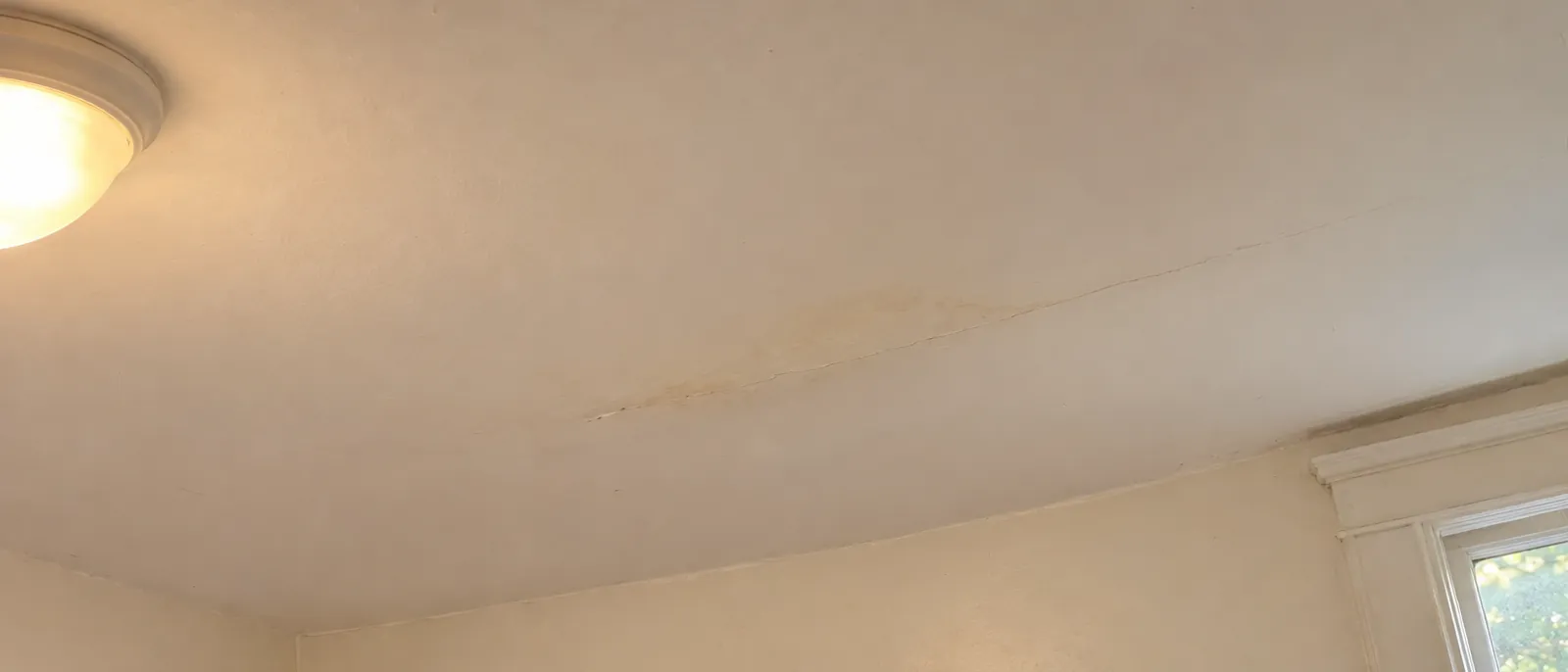
Cracked plaster, ice-dam stains, holes left between tenants and ceilings starting to sag, repaired and finished to the wall's own texture so the patch disappears under paint.
One call and we arrange for a nearby pro to come out, look over the damage and quote it.
Call 7 days, 7am–9pm · Before you call
Sending it gives the go-ahead for a reply by phone or text on this one repair. How details are handled
Expect a call from a nearby pro who handles plaster and sheetrock, to go over the damage and pick a visit time.
Plaster or sheetrock?
Smooth hard-coat, sand finish, light orange peel: the patch is finished to match what's around it.
local homes were built in 1939 or earlier, per Census estimates. That usually means plaster.
U.S. Census Bureau, ACS 2020–2024 estimatesWhich repair do you actually need? The material comes first: plaster and sheetrock are repaired differently, even for the same dent, so each card below starts there.
Loose, bulging or cracked plaster reattached or rebuilt in place, so the room doesn't have to be gutted.
Plaster and lath repairIce-dam and leak stains dried out, sealed and refinished once the roof or pipe side is sorted.
Fixing a water-damaged ceilingEvery hole, ding and anchor scar in a unit handled in one visit before the next tenant moves in.
Patching rentals between tenantsCorner, seam and spiderweb cracks read for cause first, then taped or reinforced so they stay shut.
Wall and ceiling crack repairDoorknob holes, pulled anchors and the gaps an electrician or plumber cut, closed with backing, taped and blended.
Drywall hole patchingNot sure which card fits? Text us a picture plus one line about what happened. That is usually enough to tell old plaster from sheetrock and to say which kind of repair applies, before anyone drives over.
What happens after you reach out? Four stages, and nothing is cut, scraped or patched before you've said yes to a figure.
Call, or text a wide photo and a close-up. Mention the room, roughly how big the damage is, and whether the wall is plaster or drywall if you know.
A nearby pro comes to see it in person, checks for moisture, loose plaster or a crack that keeps moving, and names a figure for you to accept or decline.
Backing, new board or base coat, tape, then compound in layers, each allowed to harden before the next goes on. Plaster usually wants more coats and more patience.
The repair is sanded or floated smooth, the surface texture imitates the neighboring wall, and you get back a surface that only needs your paint.
So what does a repair cost? It depends on four things: how big the damage is, whether it's plaster or drywall, how many coats and drying rounds it needs, and how hard it is to reach (a stairwell ceiling takes staging that a bedroom wall doesn't). For a sense of scale, the national cost guide on Fixr.com puts a typical drywall repair at roughly $200 to $550, a hole at about $60 to $200, and water-damaged drywall in one room at around $400 to $800. Those are national averages, not prices for Southbridge, and they don't cover plaster. The real figure is set at your wall, by the pro standing in front of it.
For more on how a request turns into a scheduled repair, and what kinds of jobs are covered, see what this business does, step by step.
Can a basement wall be patched while it's still damp? Usually not, and it shouldn't be. Compound spread over wet board stays soft, stains through paint and lets mold get started behind it.
Basement drywall that has wicked water up from a wet floor needs the source dealt with first: a sump that quit, a gutter dumping at the foundation, a spring thaw that found a crack. Then the board is cut back above the wet line, the cavity is left open to dry, and new moisture-resistant board goes in. If you're not sure the wall is dry, a pro can check it with a moisture meter before quoting.
Attached garages are a different question. The wall and ceiling between the garage and the house are often fire-resistant Type X board, made to hold back flames from the garage for longer. When a car door, a bike handlebar or a shelf bracket punches through it, the patch should be the same kind of board with the seams taped, so the separation keeps working. A piece of ordinary half-inch sheetrock looks fine and doesn't do the job.
When should you wait? After any flooding, give it a dry-out before scheduling the patch. A repair done a couple of weeks later on a dry wall outlasts one done right away on a damp one.
Who fixes the holes after the electrician packs up? That's usually us, once the wiring, pipe or duct work is finished and any inspection is signed off.
Here is what we tend to see. Electricians fishing new circuits through old walls cut access holes at the top plate and at each stud they cross. Plumbers open the ceiling under a bathroom to reach a drain. Heat-pump installers bore through for line sets, and cable or camera installers leave a trail of small openings. None of them are drywall finishers, and they aren't expected to be.
Closing those openings properly means squaring each one into a clean rectangle, screwing wood backing behind the edges, setting new board flush with the wall face, then taping and coating until the patch is level with the surface around it. In plaster walls the new piece is shimmed out to the plaster's thickness, so the finish coat doesn't leave a ridge you can see when the light hits it sideways.
One tip if the work hasn't started yet: ask the trade to cut neat rectangles and keep the pieces. It doesn't always save the patch, but it makes a smaller one.
Does the part of town you live in change the repair? Often it does, because the age of the house decides whether you have plaster on wood lath, plaster on brick or sheetrock.
Where McKinstry Brook meets the Quinebaug River, the Hamilton Woolen Company historic district holds a group of brick mill worker houses from the 1830s, set around a quadrangle. Interior walls in houses that old are plaster, and on outside brick walls the plaster can sit right on the masonry, so a damp patch there is a moisture question before it's a patching one.
Twinehurst Place is listed as a residential neighborhood tied to American Optical, the company that became the world's largest maker of ophthalmic products from Southbridge before it shut down in 1984. If your house there still has its original plaster, the repair is done in plaster-compatible materials, not a square of drywall dropped in.
Sandersdale is the village on the east side, out along East Main Street (Route 131) past the AO Rotary. Houses there vary, so the first question on a call is simply what the wall is made of. A photo of the edge of the hole, or of the gap behind a switch plate, usually answers it.
Town-wide, Census estimates for 2020 to 2024 put about a third of Southbridge homes as built in 1939 or earlier, and more than a fifth in the 1950s and 1960s. So plaster is common here, and so are mid-century walls that mix plaster ceilings with later drywall.
Is your town on the list? If it touches Southbridge or sits one town over, probably.
There's a sentence or two about each one on the list of towns we cover around Southbridge.
What should you have ready before you get in touch? A handful of things, and none of them take long.
Got most of that? Then the first call is short, and the quote can be specific.
Do newer homes in town crack too? Yes, though they're a small share here. Census estimates count only about 6 percent of local homes as dating from 2000 onward, and roughly another 18 percent in the 1980s and 1990s.
Those houses are sheetrock throughout, and their problems are predictable. Nail pops show up as small round bumps in a line along a stud, usually once the studs give up moisture over the first heating seasons and pull back slightly. The fix is to drive a screw beside each pop, set the old fastener, and spot and sand the area so it disappears under paint.
Settling cracks run diagonally from the corners of doors and windows, where the framing concentrates movement. If the crack is thin and isn't growing, it gets taped and refinished. If it opens wider each season, that's worth a closer look first.
Truss uplift is the one that confuses people. A gap opens along the top edge of an inside partition in winter and closes again in summer, because roof trusses bow upward as the attic gets cold and dry. Fastening the ceiling tighter doesn't stop it. The usual fix is to let the corner float: the ceiling board is left unfastened near the wall, and a trim piece fastened only to the ceiling hides the movement.
Which wall damage matters before a sale or a move-out walk-through? The things a buyer or inspector notices first: stains on ceilings, holes at eye level, and cracks that look like movement.
A ceiling stain is the one to deal with first, because every buyer asks about it. Have the roof or plumbing fixed, keep the paperwork, then have the stain sealed and the ceiling refinished. A doorknob hole, TV-mount anchors and a cracked outside corner come next. Small nail holes from pictures can usually be filled along with the paint.
What can you leave? Fine, stable hairline cracks in old plaster are part of an old house, and patching every one before a sale is rarely worth it. A long crack that has opened up, or plaster that moves when you press it, is different and should be fixed.
Timing matters more than people expect. Book the repairs first, give the compound and primer a few days, then the painter, then the listing photos. Squeezing all three into one weekend is how patches end up flashing through the new paint.
Is rental patching a big part of the work here? It is. Census estimates put renters in more than half of Southbridge's occupied homes, and about four in ten homes are in buildings with two to four units.
A turnover works best as one walk-through with one list: every hole, anchor, gouge and cracked corner in the unit, quoted together and done in one visit, so the painter can follow on a known date. If you have more than one vacant unit in the same building, they can go on the same trip.
Occupied units take a little more planning. Repairs are scheduled around the notice you give tenants, furniture gets moved away from the wall and covered, and the work area is kept tight. Leave a note of each unit's paint color and sheen, and take your own before-and-after photos for the deposit file.
More on how a unit gets turned over is on the page about rental drywall patching between leases.
Ready to get it fixed? Pick whichever is easiest for you.
Once the details reach us, a nearby repair pro calls to book a visit and look at the damage.
Call 7 days, 7am–9pm